
Bence Chiropractic | Balance Assessment and Therapy
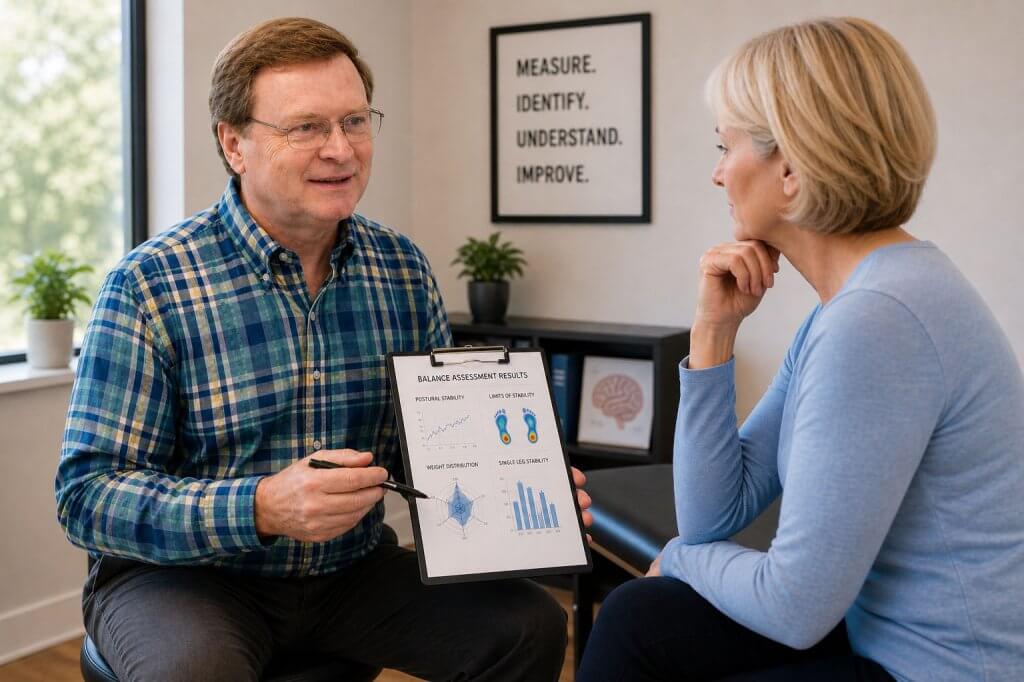
For most of the history of clinical medicine, balance was evaluated the way it is still evaluated in many practices today: a clinician watches how a patient stands, walks, or holds a pose, and forms a judgment based on what they observe. That clinical experience is valuable. But observation has real limits. It can tell you that someone’s balance is off. It has a much harder time telling you exactly where, why, and by how much.
Modern clinical balance testing has fundamentally changed what is possible. Harvard Health describes balance as requiring coordination across the central nervous system, inner ear, eyes, muscles, bones, and joints — and notes that problems with any one of those systems can affect the whole. That complexity is precisely why objective measurement matters: when multiple systems are involved, observation alone cannot reliably isolate which one is failing.
What Clinical Assessment Actually Measures
The Cleveland Clinic explains that diagnosing balance problems involves evaluating how the brain processes signals from the eyes, ears, and body — not just whether a patient feels steady. Modern assessment tools can measure postural stability, weight distribution, center-of-gravity control, single-leg stability, and limits of stability — all with precision that observation cannot replicate.
The Mayo Clinic notes that effective treatment of balance problems depends on understanding what is causing them. Two patients with similar symptoms may have completely different deficits requiring completely different interventions. That is the core argument for data-driven assessment over general exercise recommendations.
Why It Matters That Balance Predicts Health Outcomes
Research published in JAMA Otolaryngology found that balance function is significantly associated with all-cause and cause-specific mortality among U.S. adults. That finding adds significant weight to the case for proactive assessment: balance is not just a symptom of declining health, it is a measurable predictor of it. Identifying and addressing deficits early — before a fall, injury, or loss of function — is not just good rehabilitation practice. It is preventive medicine.
Seeing objective improvement is one of the strongest motivators for continuing with a therapy plan.
The ProBalance360 at Bence Chiropractic
At Bence Chiropractic in Macomb, Dr. Pavel Bence uses the ProBalance360 — a clinical balance assessment and therapy system that evaluates patients across seven scientifically validated metrics. The results guide a personalized therapy plan using real-time interactive exercises that retrain both the body’s balance systems and cognitive function simultaneously. Progress is tracked and documented at every session, giving patients and clinician a clear, objective record of improvement over time.
For more on who this type of assessment is relevant for beyond older adults, see: Why Balance Issues Are Not Just a Senior Problem. For the full research context on why balance matters at every stage of life, read: Why Balance Matters More Than Most People Realize.
Related Reading
→ Why Balance Impacts Independence and Quality of Life
→ What the CDC Says About Falls and Aging
→ How Balance Connects to Brain Health
→ Why Balance Issues Are Not Just a Senior Problem
→ Why Balance Matters More Than Most People Realize
Bence Chiropractic Wellness Center | (586) 978-9900 | www.bencechiro.com | 21 Mile and Garfield Roads, Macomb, MI